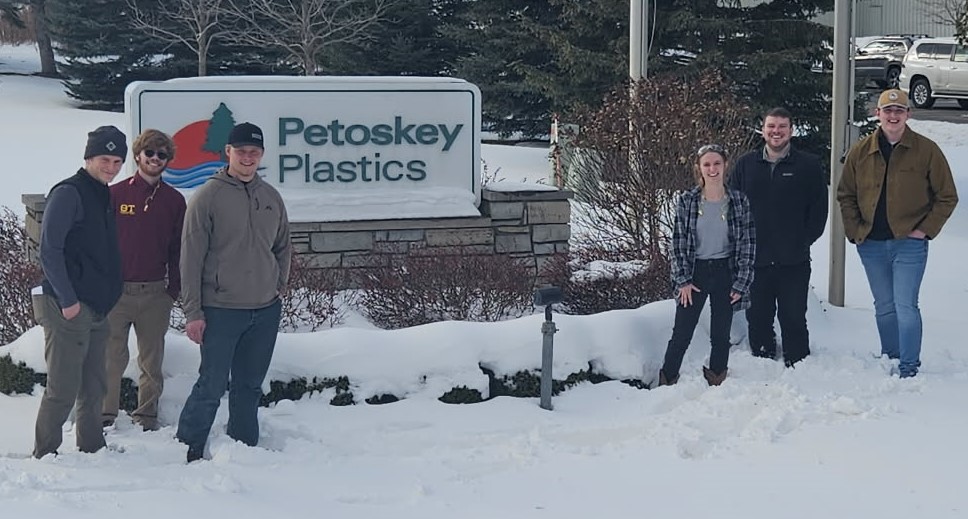
Many know our mission of earning the appreciation and respect of our customers, associates, and communities, but another core part of Petoskey Plastics’ culture is our values. There are seven: continuous improvement, customer service, innovation, performance, safety, sustainability, and teamwork. Each value is essential to how we operate internally and externally. To demonstrate a few of those values in motion, we are pleased to share a look at the year-long collaboration between Petoskey Plastics and Michigan Technological University students.
The journey begins with Petoskey Plastics sponsoring a Senior Capstone Design Project for the Mechanical Engineering program at MTU. Four seniors partnered with our Research & Development and Operations teams to advance an internal process-improvement concept through structured engineering work. This real-world experience working in a manufacturing setting with professionals in similar fields was intended to help prepare the student for post-graduation careers. Simultaneously, the Petoskey Plastics team worked with emerging talent who offered fresh perspectives and exercised our values of continuous improvement, innovation, and teamwork.
The project spanned two semesters and started in the early months of 2025. The MTU team, also known as Team 58 in their program, visited the Petoskey manufacturing location to meet in person with Darcy Wright and Kyle Brady from Petoskey Plastics’ Research and Development team. As R&D Director, Wright collaborated closely with MTU’s Senior Design and Enterprise Program advisors, drawing on their combined experience to develop a beneficial framework for the year-long program. Brady, Research & Design Engineer, engaged directly with the students to vet concepts, pressure-test ideas, and offer tactical progress support.
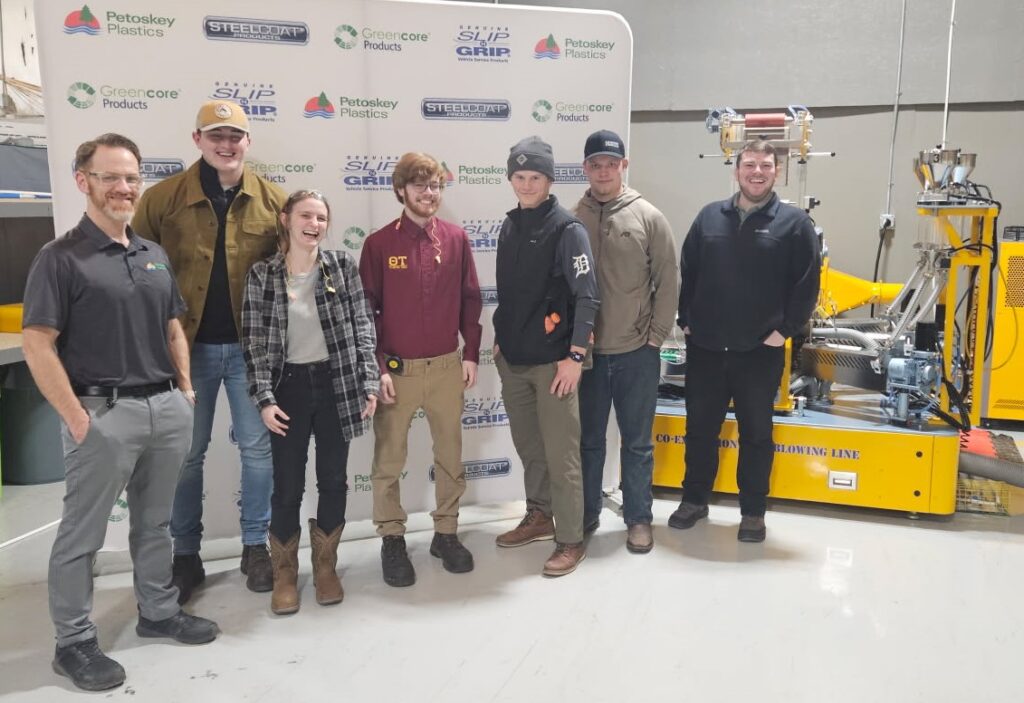
From the beginning, the student team focused on the conceptual development and validation of a custom mechanical system intended to improve efficiency and consistency in a production environment. The project focused on front-end engineering and problem-solving, and created a hands-on experience for a process that could later impact production changes.
During the project, Team 58 took a high-level problem and translated it into clear, functional requirements. The Petoskey Plastics team met regularly with the students to conduct design reviews and progress updates that mirror real-world engineering development cycles. The project was intentionally structured to immerse the students in a scenario they could experience in the workforce. The Petoskey Plastics team emphasized problem-solving, not just execution, by coaching on decision rationale and risk awareness. Through this, the students were able to evaluate multiple potential solutions and narrow down to one course of action. With a set focus, the team worked together to produce engineering documentation that would extend beyond the project timeline and remain usable in future implementations.
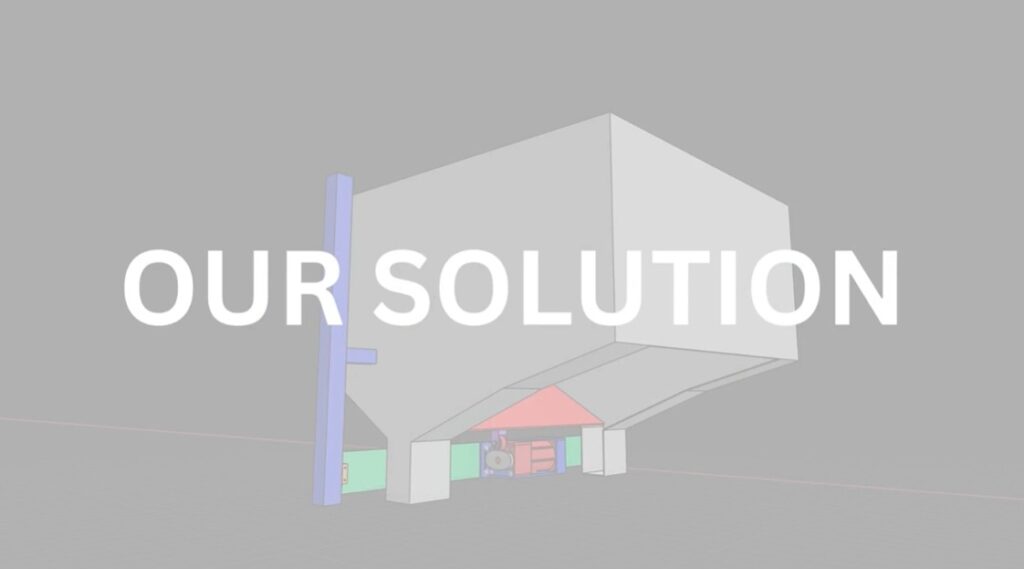
At the end of the capstone, the MTU team provided a complete concept package, not just one design. They delivered a well-documented concept addressing the original problem, along with technical drawings and visual models to illustrate the solution. Also included was a summary of design tradeoffs and recommendations for the Petoskey Plastics team to use as next steps. In all, the final product successfully bridged academic engineering and real-world manufacturing needs. Team 58 produced tangible design outcomes, strengthened our innovation pipeline, and created a compelling example of how collaborative development can deliver value beyond a single project.
At the end of the project, Michael Davenport, Associate Director of Experiential Learning Partnerships at MTU, praised the success of the crossover project, saying, “We truly appreciate your support in helping shape the next generation of engineers.” Further, Petoskey Plastics welcomed one of the students as a Research & Development Intern during the summer break between the project semesters. The student, Nick Merritt, noted his official placement at Petoskey Plastics was “very beneficial to his professional growth,” and he valued the opportunities provided by connecting with individuals throughout the company.
On the Petoskey Plastics side, Brady noted, “Partnering with the MTU Senior Design program has been a rewarding experience for our team. The students brought strong creativity, technical thinking, and professionalism to this project. We value MTU’s commitment to experiential learning and look forward to more community partnership opportunities like this in the future.”
The collaboration between Petoskey Plastics, led by Wright and Brady, and the MTU Mechanical Engineering students, with the help of their advisors, was a successful venture for all. We were fortunate to work with the bright, driven individuals who provided valuable research and solutions to improve a process in our manufacturing plant. Their innovation helped keep us striving toward our goal of continual improvement, while they immersed themselves in a skill-building, professional scenario. The Petoskey Plastics team looks forward to the bright futures these students have in engineering and the contributions they will continue to make.